The Journal · October 2, 2026
The Everything Cookie: What Each of the Seven Mix-Ins Is Doing
Two chocolates, toffee, caramel, oats, dried cherries and pretzels, in one buttery dough. That is not a kitchen-sink cookie. Each one is there for a reason, and here is what every piece does to the bite.
By Splash
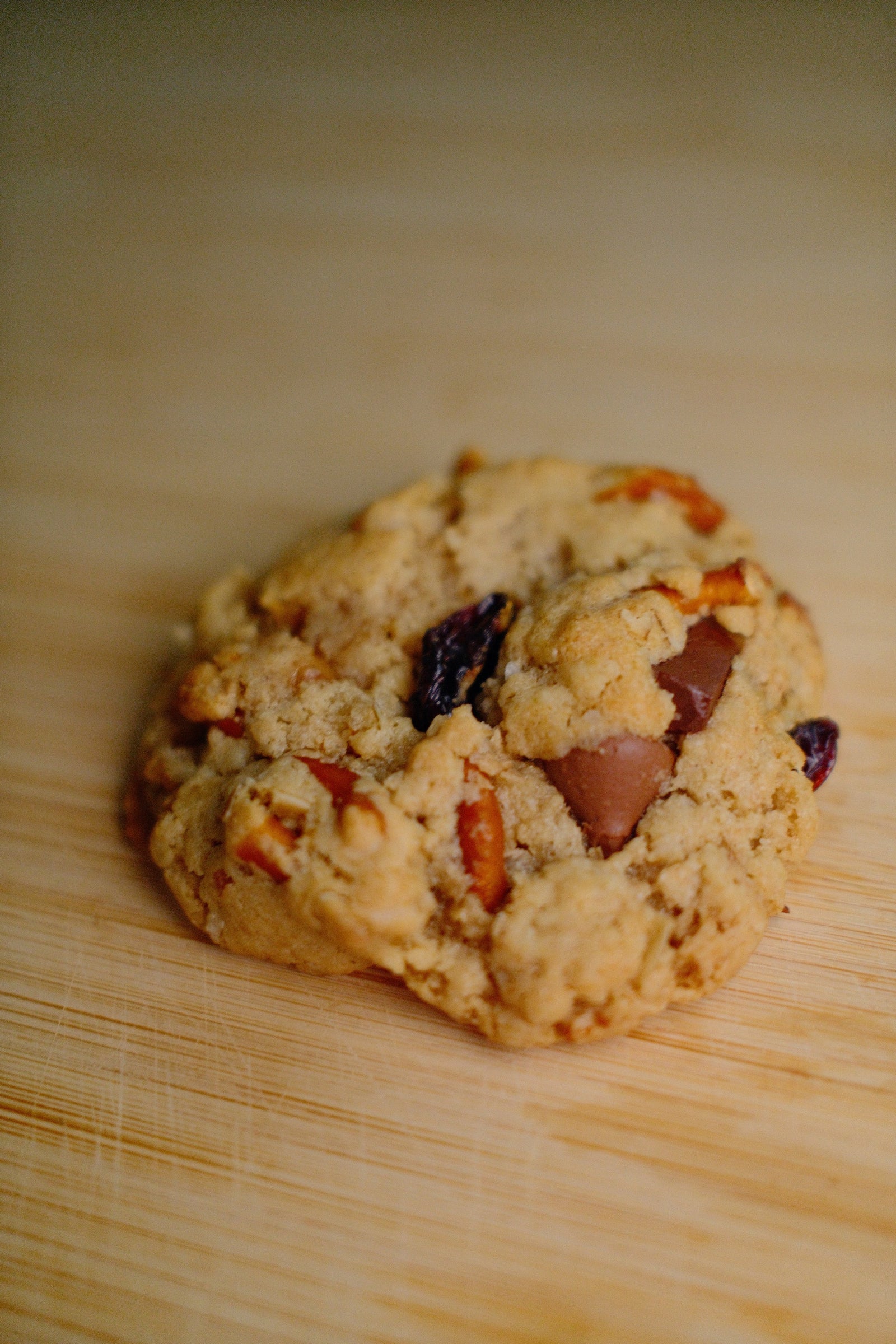
People hear "The Everything" and picture a kitchen-sink cookie: whatever was in the cupboard, thrown in. It is the opposite of that. Our mom, Michele, spent years on this recipe, and a chemical engineer does not add an ingredient because it was nearby. Each of the seven mix-ins is there to do a job that the other six cannot, and the job is balance: sweet against salty, chewy against crunchy, warm against bright. Here is what every piece is doing, and why the cookie would be worse without it.
The dough they sit in
Start with the base, because the mix-ins only make sense against it. The Everything is a rich, buttery dough sweetened with brown sugar, which brings a little molasses and a soft chew. For this cookie, the thing to know is that the base already tastes warm and caramel-leaning before anything goes in. That means the mix-ins do not have to bring warmth. They have to bring contrast.
1. Milk chocolate chips
Milk chocolate is sweet, soft and creamy, with a low melting point. In the oven it goes fully molten and then sets back into soft pockets that stay tender at room temperature. It is the comfort in the cookie, the part that reads as classic chocolate chip. On its own it would be too sweet against brown sugar and toffee, which is exactly why it is not on its own.
2. Semi-sweet chocolate chunks
Chunks, not chips, and darker. Semi-sweet chocolate has less sugar and more cocoa, so it brings a slight bitterness that keeps the whole cookie from tipping into candy. Chunks matter for texture: a chip is a uniform drop designed to hold its shape, while a chunk is an irregular piece that melts into a puddle at the edges and stays solid in the middle. You get two chocolate textures from the two chocolates, and a bite that changes depending on where you bit.
3. Toffee bits
Toffee is sugar and butter cooked until it is hard and deeply caramelized. In a cookie it does two things. Some of it stays as crunchy, glassy bits. Some of it melts in the heat and runs into the dough around it, leaving little lacy, caramelized edges where it touched the pan. That second effect is why the edges of The Everything brown the way they do. Toffee is also the bridge between the buttery base and the chocolate: it tastes like what both of them have in common.
4. Caramel
If toffee is the crunchy caramelized note, caramel is the soft one. It stays chewy after the cookie cools, which gives the center a pull that flour and sugar alone cannot. Caramel and toffee sound redundant and are not. One shatters, one stretches. A cookie with only toffee is crisp and a little brittle in the middle; the caramel is there to keep the center soft.
5. Oats
Oats are the quiet structural ingredient. They soak up some of the moisture in the dough, which helps the cookie hold its shape and stay chewy instead of collapsing into a thin wafer under the weight of everything else. They also give the dough body between the bigger pieces, so there is something to chew that is not chocolate or sugar. There are not enough oats to make this an oatmeal cookie. There are enough to make it a cookie that can carry six other things.
6. Dried cherries
By this point the cookie is sweet, buttery, caramelized and chocolatey, and it needs something to cut through all of that. Dried cherries are tart. The acid in them resets your palate between bites of chocolate and toffee, the way a squeeze of lemon does in a rich dish, and the chewiness is different from caramel's chewiness: drier, more fruit than candy. They are also the mix-in people notice last. The first bite reads as chocolate and caramel; the cherry shows up a second later, and it is the reason the second bite tastes as good as the first.
7. Pretzel twists
Salt and crunch. The pretzels bring the only ingredient that is savory rather than sweet, and salt next to caramel and chocolate makes both taste more like themselves. Pretzels specifically, rather than plain salt, because they stay crunchy in the baked cookie, where a flake of salt dissolves. They are the reason the cookie is described as sweet and salty rather than just sweet, and the reason it is crunchy at the same time as being chewy.
Why seven, and not six or eight
Look at the list as pairs and the logic is visible. Two chocolates, one sweet and one dark. Two caramelized sugars, one crunchy and one chewy. One tart fruit to cut the richness. One salty crunch to sharpen it. And oats to hold it all together. Take any one out and you lose a contrast: no cherries and it is cloying, no pretzels and it is flat, no oats and it spreads, no semi-sweet and it is candy. Add an eighth and it has to replace one of these jobs or duplicate it, and duplicates are how kitchen-sink cookies happen.
Then there is the problem of actually making it. Seven add-ins means seven bags from the store, most of them bought for one batch, and a recipe where the ratio between them matters as much as the ratio of flour to butter. That is the part that moved this from a family recipe into a kit. In The Everything kit, all seven are already weighed into the dry pouch at the proportion Michele settled on, so the balance above arrives in the box. You add water, mix for two minutes, scoop six and bake, and the bake page handles the timing. It makes six bakery-style cookies, and it contains wheat, milk, egg, soy and almond, which you can read more about in the FAQ.
If you make one, pay attention to a single bite and try to find all seven. Most people can on the second cookie.
More from the journal
October 2, 2026
Why Do My Cookies Spread? The Science and the Fixes
Flat, greasy, one-giant-cookie-on-the-sheet cookies come from a short list of causes: warm fat, too little flour, the wrong sugar balance, a cool oven or a hot pan. Here is what is happening in the dough, and how to fix each one.
October 2, 2026
How to Brown Butter for Cookies
Brown butter is the single biggest flavor upgrade a cookie can get, and it takes eight minutes and a light-colored pan. Here is how to do it, what goes wrong, and how to use it in a recipe without wrecking the texture.